
By Bill Brenner
There’s a growing sense, especially among experienced editors, that AI is the beginning of the end for writing and editing as professions. You don’t have to look far to find someone arguing that the work is being automated out from under us.
That reaction makes sense. The tools are fast, increasingly capable, and in some cases, good enough to pass a quick read. When something can generate a clean draft in seconds, it forces a hard question: where does that leave the people who used to do that work?
But “this changes the job” is not the same as “this eliminates the job.” We’ve seen this movie before: The Internet didn’t erase editors. It changed how content was created, distributed, and monetized, and it forced people to adapt.
Three decades later, most of us are still here.
I’ve Had the Same Doubts
I’m not immune to this. Using AI forces you to confront some uncomfortable questions:
If it can draft faster than I can, where do I add value? Am I helping build something that eventually sidelines me? What happens when organizations decide “good enough” is good enough?
Those thoughts show up quickly once you start using these tools in a real workflow, and they don’t go away just because you understand how the technology works. What changes is how you see the gap between what AI produces and what actually holds up.
The Gap Still Matters
AI can generate structure, summarize inputs, and get you to a usable starting point quickly. That’s real value. It removes friction from parts of the job that were already somewhat repeatable.
But it doesn’t know your audience. It doesn’t make judgment calls about tone, timing, or what should be emphasized or left out. It doesn’t push back when something feels off. It doesn’t connect ideas across context the way an experienced editor does.
That gap—between output and judgment—is still there. If anything, it becomes more important when there’s more content being produced, faster.
The Real Risk Is Opting Out
The bigger issue isn’t that AI exists, but how people respond to it.
If you decide not to use it at all, you’re not holding the line on quality. You’re stepping away from the process that’s actively reshaping your field.
These tools are going to be used. By your colleagues, competitors, the people publishing more content, more quickly, whether it’s good or not.
The editors who stay relevant will be the ones who understand how the tools work, where they fall short, and how to push them toward something better. The ones who don’t will have less influence over the outcome.
What Changes in Practice
In practical terms, AI shifts where your time goes.
You spend less time getting to a first draft and more time refining it into something worth reading. Less time organizing raw material and more time deciding what actually matters. Less time staring at a blank page, more time shaping the final product.
And in some cases, it opens up things that were previously constrained by time or resources.
One example: I use AI heavily for image creation. Instead of digging through stock libraries and settling for something loosely related to the topic, I can generate visuals that directly reflect the point of the article. It tightens the connection between the content and how it’s presented, and it does it without adding another layer of production overhead.
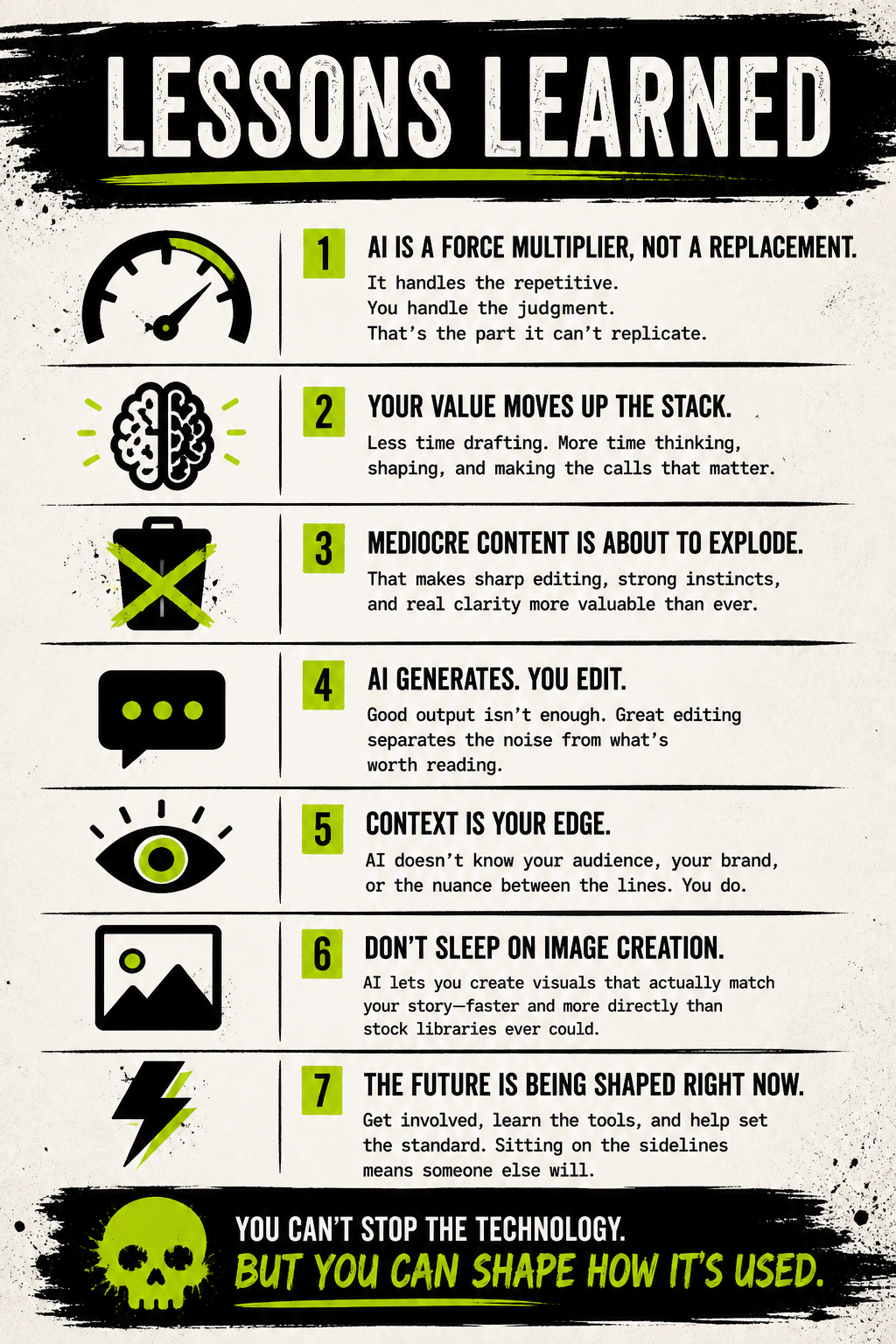
What I’ve Learned So Far
A few things have become clear through actual use:
- AI is good at accelerating processes. It is not good at replacing judgment.
- The value of editing shifts upward. The mechanical parts get faster; the thinking becomes the differentiator.
- There’s going to be a lot more mediocre content in circulation. That raises the importance of people like you.
- Using AI doesn’t make you less of an editor. It forces you to be more intentional about what editing actually is.
You Don’t Get to Pause This
It’s tempting to treat AI as something you can wait out. See how it develops. Let other people figure it out first. That ignores an important truth: To change the world for the better, you have to show up.
The technology is already embedded in workflows, whether formally or informally. Decisions are being made about how it’s used, what’s acceptable, and what “good” looks like in this new environment.
Editors should be part of that. Not as passive observers, but as the people who understand quality, clarity, and audience better than anyone else in the process.
AI changes the job. It doesn’t remove the need for it. But choosing not to engage with it does create risk for your relevance, your influence, and your ability to shape what comes next.
You can keep doing things the way you always have and hope that holds. Or you can use the tools, understand them, and apply the same standards you always have, just in a different environment.
One of those paths keeps you in the work. The other doesn’t.

Bill Brenner is a cybersecurity content strategist, journalist, and editor with more than two decades of experience helping security leaders navigate a rapidly evolving threat landscape. As Vice President and Editor-in-Chief at CYBR.SEC.Media, he operates at the intersection of cybersecurity, storytelling, and community, translating complex technical issues into clear, human-centered insights.
Previously, he held senior leadership roles at CyberRisk Alliance, leading audience content strategy and contributing to industry research and thought leadership. He is known for his data-driven perspective, deep roots in cybersecurity journalism, and focus on the human side of security — from practitioner challenges to workforce development and mental health.

Bill, your article makes some good points. I’m already in the camp of “use AI as a tool, not a replacement”, but I will be sure to direct others to your article if needed. I’m glad to know other people in the publishing field see the good in AI.
I appreciate this insight, and the recognition that opting out completely will not serve an editor well in the long run.